Ultraclean monolayer amorphous carbon yields a high-precision proton beam
Ångström-scale polygonal rings in monolayer amorphous carbon (MAC) enhance its electronic and mechanical properties while providing unique ångström pores for precise subatomic species separation, essential for advancements in catalysis, energy and medicine. However, the absence of an industrial-scale synthesis method for intrinsic MAC has limited its technological applications compared with graphene and bulk amorphous materials. Herein, a research team led by Professor Lu Jiong, Chief Principal Investigator from the Energy and Environmental Nanotech Research Platform of NUSRI Suzhou, in collaboration with Professor Zeng Xiaocheng from City University of Hong Kong and Assistant Professor Zhao Xiaoxu from Peking University, has developed an industry-compatible disorder-to-disorder synthesis approach to achieve wafer-scale ultraclean MAC (UC-MAC) within a timescale of seconds, featuring optimised ångström polygons without detectable metal contamination, and nanosized pores. It could revolutionise proton therapy for cancer patients, and advance technologies in medicine and other areas such as energy devices and flexible electronics. The results were published in the journal Nature Nanotechnology.
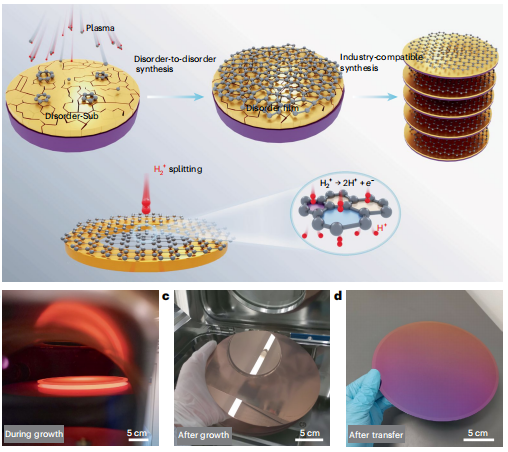
△Disorder-to-disorder synthesis and application of wafer-scale UC-MAC